





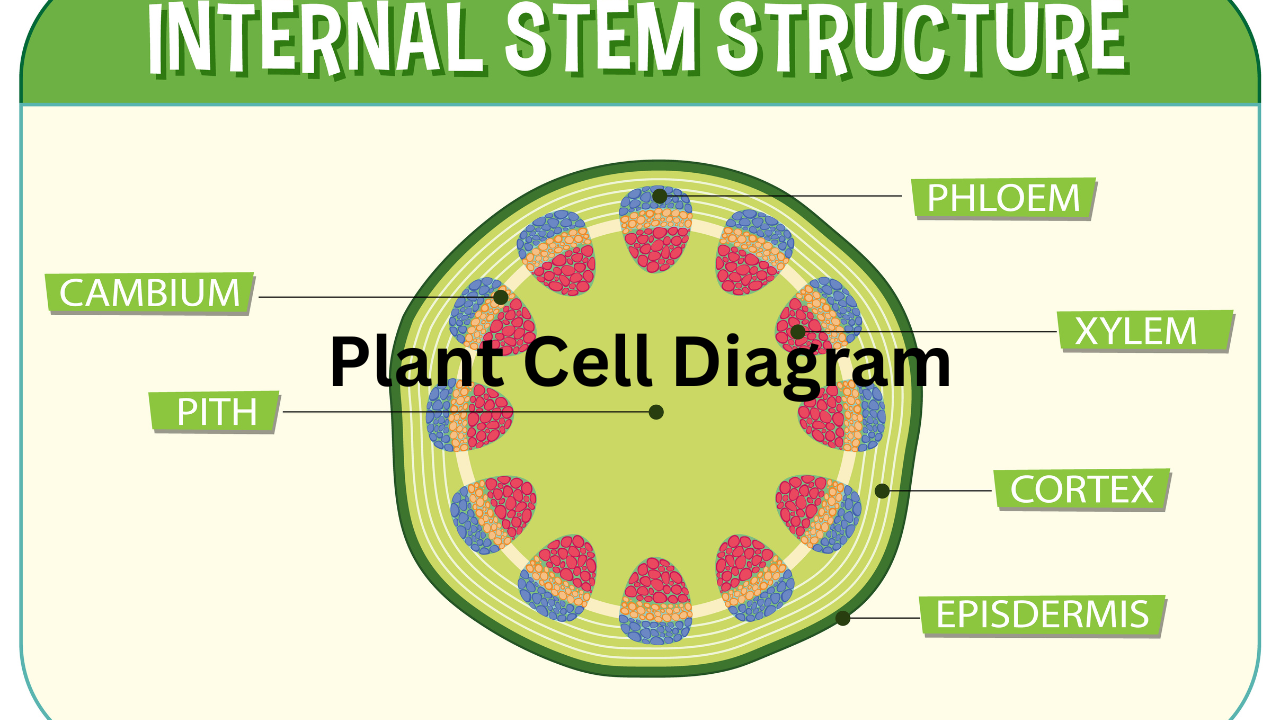
A plant cell diagram is one of the most important learning tools in biology. Whether you are a school student, a college learner, or someone preparing for competitive exams, understanding a plant cell through a clear diagram helps you visualize how life functions at a microscopic level. Plant cells are the basic building blocks of plants, and their structure is unique compared to animal cells.
In this detailed guide, we will explore everything you need to know about the plant cell diagram, including its definition, importance, structure, labeled parts, functions, and tips for drawing and memorizing it easily. This article is written in a simple, engaging, and professional style to help you fully understand the topic and perform better in exams.
What Is a Plant Cell Diagram?
A plant cell diagram is a visual representation of a plant cell showing its internal structures and organelles. It explains how different parts of the cell are arranged and how they work together to keep the plant alive. Diagrams are especially useful because plant cells contain several specialized structures that are not found in Animal cells.
By studying a plant cell diagram, learners can understand complex biological concepts in a simple and visual way. It also improves memory retention, as diagrams are easier to recall than long textual explanations.
Importance of Studying a Plant Cell Diagram
Understanding a plant cell diagram is essential for several reasons. First, it helps students clearly identify each part of the cell and its specific function. Second, it builds a strong foundation for advanced topics such as photosynthesis, respiration, and plant physiology.
Plant cell diagrams are commonly asked in exams, where students are required to draw, label, or explain them. A clear conceptual understanding makes it easier to score well. Moreover, diagrams play a crucial role in understanding how plants grow, produce food, and maintain balance in ecosystems.
Basic Structure of a Plant Cell
A plant cell is a eukaryotic cell, meaning it has a well-defined nucleus and membrane-bound organelles. The overall shape of a plant cell is usually rectangular or box-like due to the presence of a rigid cell wall.
The plant cell diagram typically shows both outer and inner components. Each component has a specific role, and all parts work together to ensure proper cell function and survival.
Cell Wall in a Plant Cell Diagram
The cell wall is the outermost layer of a plant cell and one of its most distinctive features.It provides shape, strength, and protection to the cell. In a plant cell diagram, the cell wall is shown as a thick boundary surrounding the cell membrane.
The cell wall is mainly composed of cellulose, which makes plants strong and upright. It also protects the cell from mechanical damage and prevents excessive water intake, which could cause the cell to burst.
Cell Membrane and Its Role
Just inside the cell wall lies the cell membrane, also known as the plasma membrane. In a plant cell diagram, it appears as a thin layer surrounding the cytoplasm.
The cell membrane controls the movement of substances in and out of the cell. It is selectively permeable, meaning it allows some materials to pass through while restricting others. This regulation is essential for maintaining the internal balance of the cell.
Cytoplasm in a Plant Cell Diagram
The cytoplasm is a jelly-like substance that fills the interior of the cell. It is clearly shown in a plant cell diagram as the area between the cell membrane and the nucleus.
Most cellular activities take place in the cytoplasm. It holds all the organelles in place and allows materials to move within the cell. The cytoplasm also plays a key role in metabolic reactions.
Nucleus: The Control Center of the Cell
The nucleus is one of the most important parts of a plant cell diagram. It is usually located near the center of the cell and contains the genetic material of the plant.
The nucleus controls all cellular activities, including growth, metabolism, and reproduction. It contains DNA, which carries instructions for protein synthesis and cell division. A well-labeled plant cell diagram clearly shows the nucleus along with its surrounding nuclear membrane.
Chloroplast and Photosynthesis
Chloroplasts are unique organelles found only in plant cells and are a key highlight of any plant cell diagram. These green-colored structures contain chlorophyll, the pigment responsible for photosynthesis.
Photosynthesis is the process by which plants make their own food using sunlight, carbon dioxide, and water. The cytoplasm is a jelly-like substance that fills the interior of the cell.
This makes chloroplasts essential for plant survival and life on Earth.
Vacuole and Its Function
The vacuole is a large, central organelle in plant cells and is prominently shown in a plant cell diagram. It often occupies most of the cell’s interior.
The vacuole stores water, nutrients, and waste materials. It also helps maintain turgor pressure, which keeps the plant cell firm and supports the overall structure of the plant. Without a large vacuole, plants would lose their rigidity.
Mitochondria: The Powerhouse of the Cell
Mitochondria are responsible for energy production and are found in both plant and animal cells. In a plant cell diagram, mitochondria are usually shown as oval-shaped structures with folded inner membranes.
They convert food molecules into energy through the process of cellular respiration. This energy is required for growth, repair, and other vital cellular processes.
Endoplasmic Reticulum in a Plant Cell Diagram
The endoplasmic reticulum, often abbreviated as ER, is a network of membranes shown near the nucleus in a plant cell diagram. It is divided into two types: rough endoplasmic reticulum and smooth endoplasmic reticulum.
The rough ER has ribosomes attached to it and is involved in protein synthesis. The smooth ER lacks ribosomes and helps in lipid synthesis and detoxification of harmful substances.
Ribosomes and Protein Synthesis
Ribosomes are tiny, dot-like structures found either floating in the cytoplasm or attached to the rough endoplasmic reticulum. In a plant cell diagram, they are usually shown as small granules.
Their main function is protein synthesis. Proteins are essential for cell structure, enzyme activity, and overall plant growth and development.
Golgi Apparatus and Material Transport
The Golgi apparatus is another important organelle shown in a plant cell diagram. It appears as a stack of flattened sacs.
Its main function is to modify, package, and transport proteins and lipids to different parts of the cell. The Golgi apparatus ensures that materials reach their correct destinations efficiently.
Differences Highlighted by a Plant Cell Diagram
A plant cell diagram clearly shows how plant cells differ from animal cells. The presence of a cell wall, chloroplasts, and a large central vacuole are key differences.
These structures allow plants to perform photosynthesis, maintain shape, and store large amounts of water. Understanding these differences is crucial for grasping basic biological concepts.
How to Draw a Plant Cell Diagram Easily
Drawing a plant cell diagram becomes easy with practice and a step-by-step approach. Start by drawing a rectangular outline to represent the cell wall. Inside it, draw a thin line for the cell membrane.
Next, sketch the large central vacuole, nucleus, and other organelles like chloroplasts and mitochondria. Label each part neatly. Always keep your diagram clean, simple, and well-proportioned to score maximum marks in exams.
Tips to Memorize a Plant Cell Diagram
To memorize a plant cell diagram effectively, focus on understanding rather than rote learning. Visual repetition helps a lot, so practice drawing the diagram multiple times.
Using color codes for different organelles can also improve memory. Associating functions with each part makes it easier to recall information during exams or quizzes.
Educational Value of a Plant Cell Diagram
A plant cell diagram is not just an exam topic; it is a foundation of biological science. It helps students understand how plants grow, produce oxygen, and support life on Earth.
From agriculture to environmental science, the knowledge of plant cells plays a significant role. A clear understanding of plant cell diagrams opens the door to advanced studies in botany, genetics, and biotechnology.
Conclusion
The plant cell diagram is a powerful learning tool that simplifies complex biological structures into an easy-to-understand visual format. By studying each part of the diagram and understanding its function, learners can build a strong foundation in biology.
Whether you are preparing for exams or simply curious about how plants work, mastering the plant cell diagram will greatly enhance your knowledge. With regular practice and clear concepts, this topic becomes both interesting and rewarding.
Also Read: Jaylen Brown Vanessa Bryant: Why the Internet Is Curious About This Unexpected Connection




One thought on “Plant Cell Diagram: A Complete, Easy-to-Understand Guide for Students and Learners”
Comments are closed.